I’ve been working in Luxembourg for more than 13 years now, but I have the feeling that only since my kids arrived have I actually lived in Luxembourg. Mapping the playgrounds, finding new walks, dealing with the schoolmasters and the administration, worrying about their school commute.
Living in a place means getting involved in fixing its problems.
One of the things that looms big on our horizon is the secondary school choice for my older son. The Luxembourgish system seems to force (offer?) plenty of choices: technical vs classical track, international education vs national, private vs public… I’m an engineer, and the core reflex as an engineer is: “measure first” — so I wanted to find ways to compare all these options.
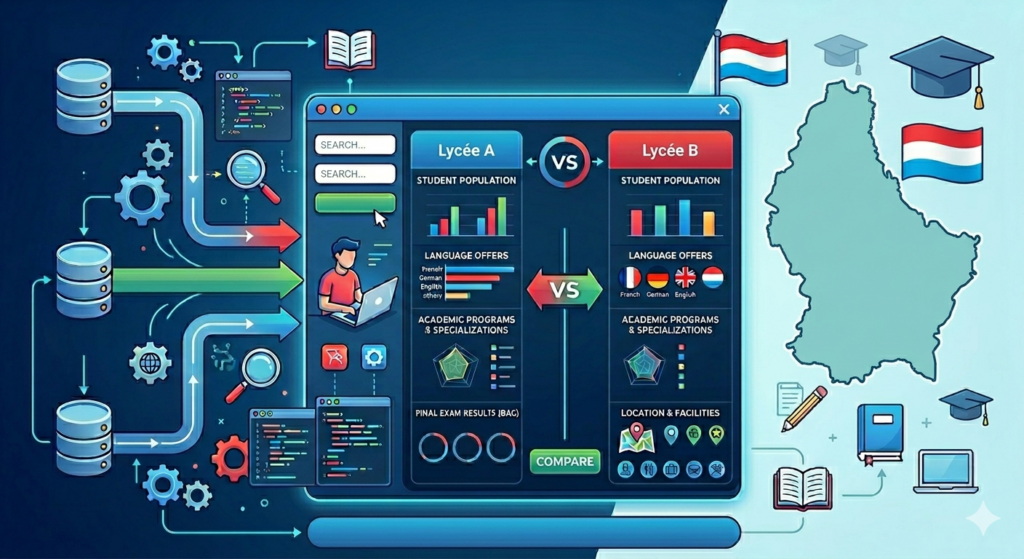
This made me build wiel.lu — a tool to navigate the high-school offerings in Luxembourg. Wiel means “choice” in Luxembourgish, and the project is the fourth stop on a journey that started last summer with obsidize, continued through wee.lu and breakthrough.game — each project more ambitious, each one built faster.
Initially, I wanted to go further: identify the outcomes, results, split them by first languages and origins — things that really count in order to actually make a choice and not a guess. But that data doesn’t exist publicly. Luxembourg even skipped PISA 2022, creating a seven-year gap — the next results won’t land until September 2026. That will be a significant moment: a public, international benchmark after years of silence. I intend to analyse those results in the open — how Luxembourg’s scores compare to 2018, what changed, and what it means for the families navigating the system today.
As it is, wiel.lu is still an interesting tool: it gives you a clear view of what is available in your proximity, how the passing rates compare to the national min/max, how these rates compare between different schools. But it doesn’t say anything about the outcomes you could expect if you choose one school over another. Which basically means there is no choice — the word comes from the French “choix,” from Latin “cogitatus”: to think, to consider. You need data to think, you need data to consider — otherwise it’s only guessing.
So I learned two things from this project:
- My “AI-augmented” development flow keeps improving — wiel.lu is more complex and refined than wee.lu or breakthrough.game, and it took less time to build. From idea to a working, deployed application in about three weeks of early mornings.
- As it stands, the best way to navigate the school system in Luxembourg is based on word of mouth and insider knowledge — which is something that worries me. The opacity of the education system here is real, and worth questioning. Whether the upcoming PISA results validate the current approach or raise new questions — either way, they deserve to be examined publicly.
Give a spin to wiel.lu — tell me what you think, both about the app and about the general education topic.
a very much needed app as you are abosultly right- the opacity here is worrying!! good luck and let’s see some true outcomes🥰. A change is needed!